Hana sees Korean Air profit growth in 2027; iM highlights LCCs
Hana expects merger savings to support Korean Air's 2027 profit growth. iM highlights potential LCC earnings upgrades for the fourth quarter of 2026 and first quarter of 2027.

Market data: Korea Exchange regular-session close & Hana Bank USD/KRW reference rate, 2026-11-16 (KST)
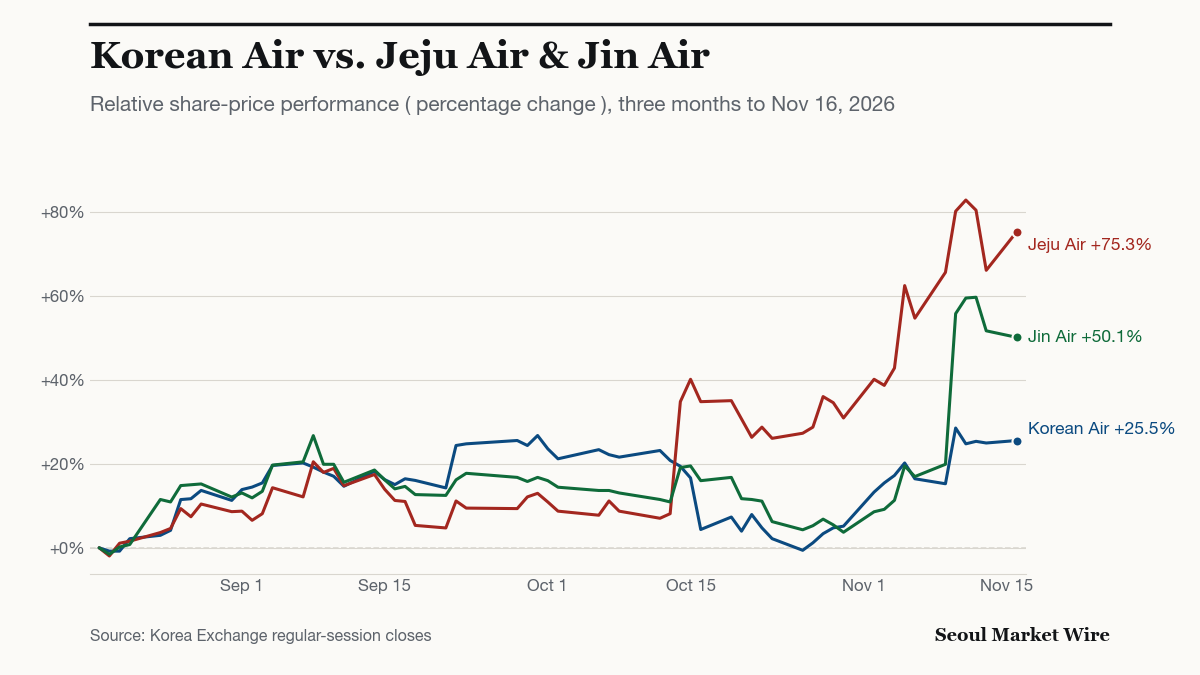
Korean Air offers the most stable prospect for airline profit growth in 2027 in Hana Securities’ Nov. 10 outlook, while iM Securities’ Nov. 9 analysis highlights potential earnings upgrades at low-cost carriers for the fourth quarter of 2026 and the first quarter of 2027.
The distinction is between full-year merger benefits and a nearer-term improvement tied to demand and fuel prices. Hana expects cost efficiencies from Korean Air’s integration of Asiana Airlines. For low-cost carriers, iM’s case depends on strong Japan travel demand continuing as fuel costs ease.
Who benefits from lower costs?
For Korean Air, the integration should bring savings and benefits across passenger and cargo operations, according to Hana. The brokerage says airlines defended profitability in 2026 through fare increases after the Middle East war drove up fuel prices. Its 2027 forecast assumes that oil prices retreat and the won strengthens.
Airline shares had already rallied in the week ended Nov. 6. Jeju Air gained 18.4%, Jin Air rose 13.0% and Korean Air advanced 11.8%, according to iM.
The brokerage reported WTI at $90.8 a barrel as of Nov. 6, down 12.8% week on week, and Singapore kerosene at $158.6 a barrel, down 5.9%. Its analysts see room to raise LCC earnings estimates if lower fuel costs accompany sustained Japan demand; the report presents that as a conditional opportunity.
What does passenger demand show?
Outbound traveller numbers should rise 7% year on year in 2027, Hana forecasts. It also expects demand to remain strong on Japan and China routes. For cargo, rising outbound volumes from Korea and limited widebody capacity should support freight rates, in the brokerage’s assessment.
October traffic figures provide evidence of Japan-route demand. In its Nov. 9 review, Eugene Investment & Securities reported 9.13 million international passengers across Korean airports, up 10% from October 2025.
At Incheon, Japan routes carried 1.97 million passengers, up 25% year on year. Passenger numbers grew faster than flight numbers, which increased 18%, lifting passengers per flight by about 6%. China-route passenger traffic rose 19%.
The Americas figures had a different composition. Passenger traffic on those routes increased 15%, or about 87,000 passengers, with transfer passengers accounting for about 77,000 of the increase, according to Eugene. Across Incheon, transfer traffic rose 75% to 660,000 passengers; the analysts attributed part of that growth to a low comparison base.
What is the separate issue at Hanjin KAL?
The ownership contest at Hanjin KAL is separate from the airlines’ operating forecasts. A Shinhan Securities transport weekly listed on Naver on Nov. 9 put Hoban’s group holding at 20.69% of common shares, compared with 20.58% for chairman Cho Won-tae and related parties.
That report described Cho’s plan to buy 325,000 shares, with completion expected in December. If completed, and assuming no other changes in holdings or shares outstanding, the purchase would raise Cho and related parties’ combined stake to about 21.07%.
Sources
- Hana Securities — Leaving the turmoil behind in 2027 (Nov. 10, 2026) stock.naver.com
- Shinhan Securities — Transport Weekly: Hanjin KAL control dispute update (Naver listing: Nov. 9, 2026) stock.naver.com
- iM Securities — Lower oil prices and strong Japan travel demand come to the aid of low-cost carriers (Nov. 9, 2026) stock.naver.com
- Eugene Investment & Securities — October air traffic data: Japan at a record (Nov. 9, 2026) stock.naver.com