Korea's 3.9% growth forecast and the KOSPI's 5.21% fall before the BOK decides
KDI's 2027 forecast leans on semiconductors, IBK's third-quarter sample shows earnings concentrated in four companies, and Hana's 2027 bonus model rests on the same chip cycle. Friday's sell-off came ahead of the Bank of Korea's November 26 decision.

Market data: Korea Exchange regular-session close & Hana Bank USD/KRW reference rate, 2026-11-20 (KST)
A Two-Day Rebound Reversed
On Wednesday, November 18, the KOSPI rose 1.99 percent to about 5,067. On Thursday it added 1.39 percent, closing near 5,138. It looked like a recovery. Kiwoom Securities’ flow table carried a warning. Foreign investors were net sellers on the KOSPI on November 16, by about 1.34 trillion won, and on November 17, by about 1.41 trillion. The two cited Kiwoom reports both show foreign net selling continuing on November 18, the first day of the rebound, at about 258 billion won in one table and about 340 billion won in another. Both show net selling. The selling narrowed, yet it did not reverse. After U.S. equities fell more than 2 percent on Thursday, November 19, New York time, the KOSPI dropped 267.93 points, or 5.21 percent, on Friday, November 20, to about 4,870, below where it stood before the rebound began. The KOSDAQ lost 5.71 percent, to about 646. Hyundai Motor, outside the chip trade, fell 4.67 percent to 255,000 won. So how can the state-run Korea Development Institute raise its 2027 growth forecast to 3.9 percent, while foreign investors net sell 45.094 trillion won of Korean shares across September and October, and the index loses 5.21 percent in a single session?
Two-Thirds of Growth, Four Names Behind the Beat
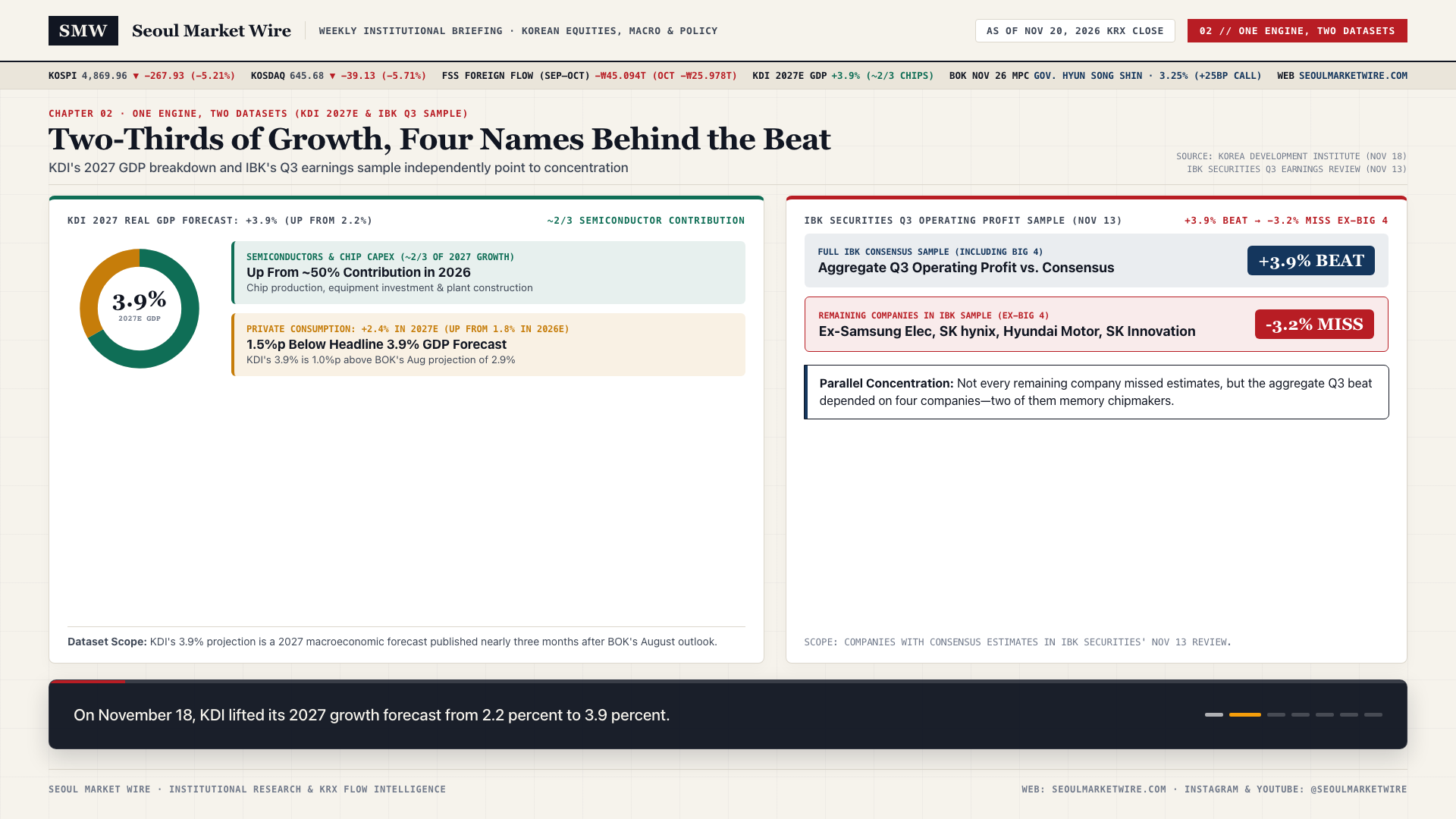
On November 18, KDI lifted its 2027 growth forecast from 2.2 percent to 3.9 percent. That is a full percentage point above the Bank of Korea’s August projection of 2.9 percent, though the two were published almost three months apart. Now look at KDI’s own breakdown. Semiconductor production, related equipment investment and plant construction supply roughly two-thirds of the growth it expects in 2027, up from about half in 2026. KDI forecasts private consumption growth of 2.4 percent in 2027, up from 1.8 percent in 2026, yet still well below the 3.9 percent headline. The forecast covers the whole economy, while much of the expansion comes from chips. Corporate earnings show a parallel shape. In IBK Securities’ November 13 review of companies with consensus estimates, aggregate third-quarter operating profit beat expectations by 3.9 percent. Remove four companies—Samsung Electronics, SK hynix, Hyundai Motor and SK Innovation—and the rest of IBK’s sample missed by about 3.2 percent. The aggregate beat depended on four names, two of them memory makers. One is a 2027 macro forecast and the other a third-quarter earnings sample from a different institution, yet both point to concentration.
What a Fivefold Chip Bonus Pool Can and Cannot Do
Chip profits can reach households through bonuses, and Hana Securities sized that channel on November 17. Hana estimates that bonuses immediately convertible into cash at Samsung Electronics and SK hynix could total 21.9 trillion won in 2027, up nearly fivefold from 4.4 trillion won in 2026. These are projected amounts, not confirmed payouts. Applying a 27 percent cumulative spending response gives about 5.9 trillion won in consumption associated with the projected payouts, part of which Hana expects to reach department stores. A broad recovery would need more. Hana warns that if gains stay confined to dividends and bonuses at two companies, the wider effect could be limited, and its separate 2026 response curve partly relies on assumed spending after July. Moreover, those projected payouts belong to 2027, while the Bank of Korea decides on Thursday, November 26, 2026. Shinhan Securities forecasts a 25-basis-point hike to 3.25 percent from October’s 3.00 percent hold, which Kiwoom describes as the prevailing market expectation. In October, the central bank expected inflation to stay above target for a considerable period, while Kiwoom judges chip gains have spread only modestly to domestic demand. In Washington, Kiwoom also forecasts a 25-basis-point Federal Reserve hike in December.
When the Single Engine Meets a Global AI Test
With roughly two-thirds of Korea’s projected 2027 growth resting on semiconductors, global AI valuation and financing doubts travel quickly to Seoul. On November 19, Anthropic’s initial public offering was priced at 83 dollars; the shares opened at 111 dollars and 50 cents, and closed the first session at 97 dollars and 17 cents. That left the stock 17.1 percent above the IPO price, but 12.9 percent below the opening trade. Daishin Securities argued that a durable Korean rebound needs clearer proof of AI profitability alongside a return of foreign buyers. IBK Securities flagged refinancing and project-delay risks at Oracle and GPU-focused cloud providers known as neoclouds, though both IBK and iM Securities judged the risk of a system-wide credit crisis to be limited. Meanwhile, a U.S. Bureau of Industry and Security interim final rule announced on November 16 addresses remote access to advanced chips through third-country data centers; its direct effect on GPU orders is not quantified in the evidence presented here. And on November 19, Eugene Securities warned that customer budget constraints could push memory prices into a gradual correction even while physical supply stays tight.
₩45.094 Trillion in Foreign Net Selling, Three Target Cuts
Two measures show the pressure on Korean equities, though neither reveals a single investor motive: foreign net selling and target cuts. Financial Supervisory Service monthly settlement figures, reported by Asia Economy, show foreign investors net sold 19.116 trillion won of listed Korean shares in September and 25.978 trillion in October. That totals 45.094 trillion won across two months. This is a monthly settlement series, unlike the daily exchange tallies quoted earlier, and it predates Anthropic’s November 19 listing: the market was already under heavy outflow pressure. Next, in our selected sample of ten brokerage reports with price targets dated November 19 and 20, three lowered their targets and seven left them unchanged. Kiwoom lowered its ISU Petasys target 31.6 percent to 130,000 won, applying a lower target multiple of 22.1 times 2027 earnings after global AI hardware peers compressed, while flagging raw-material costs and early yields on multilayer boards. Daishin cut Park Systems 27.8 percent to 260,000 won. Kiwoom cut LEENO Industrial 19.2 percent to 97,000 won, citing softer smartphone demand and projecting fourth-quarter operating profit at 41.8 billion won, 14.3 percent below consensus. All three kept Buy ratings, and Kiwoom still forecast annual earnings growth at both ISU Petasys and LEENO.
A Rebalancing Model and a Non-Chip Earnings Case
Does the selling show where capital is rotating instead? No dataset here measures actual cross-sector rotation, though two cases test the boundary. First, inside semiconductors. Using November 12 weights, Hana Securities models potential selling of about 200 billion won in Samsung Electronics and buying of about 300 billion won in SK hynix around a November index review. Hana describes the pair as nearly neutral overall, with separate estimated flows netting to roughly 100 billion won of buying across the two chipmakers. Yet this is a conditional index model with an unconfirmed implementation date, not observed trading or evidence of a direct transfer between the two stocks. Second, outside AI hardware. In ten brokerage reports published on November 4, price targets for Korea Aerospace Industries ranged from 135,000 to 186,000 won. For a historical comparison from that report window, the stock closed at 104,200 won on November 13, below all ten targets. Eugene Securities forecasts about 60 aircraft deliveries in 2027 and about 90 in 2028. Against that, iM Securities attributed delivery delays on LAH light armed helicopters to an engine defect, and as of November 4 Eugene estimated an 8.2 trillion won gap to KAI’s 2026 order target. Those targets outline a non-chip earnings debate, not proof that capital has rotated there.
Concentration vs. Cause: Three Tests for Nov. 23–27
The evidence points to concentration, not a proven cause of Friday’s decline. KDI’s 2027 growth forecast and Hana’s projected 2027 bonus pool lean heavily on semiconductors, while IBK’s third-quarter sample turns from a 3.9 percent aggregate beat into a 3.2 percent miss once Samsung Electronics, SK hynix, Hyundai Motor and SK Innovation are excluded. On our reading, that concentration leaves Korean equities sensitive when confidence in AI investment weakens. Three developments merit attention next week. First, U.S. data: S&P Global’s flash PMIs on Monday, November 23, at 11:45 p.m. Korea time, followed on Wednesday, November 25, at 10:30 p.m. Korea time, by the second estimate of third-quarter GDP and October personal income and outlays, with Kiwoom citing a 3.2 percent year-on-year consensus for core PCE inflation. Second, the Bank of Korea on Thursday, November 26, where Kiwoom calls a 25-basis-point hike to 3.25 percent the prevailing expectation. Watch Governor Hyun Song Shin’s press conference: Shinhan says the meeting could weaken expectations that tightening ends at 3.25 percent while leaving open a dissent for a hold, and Kiwoom projects another hike in early 2027. Third, watch whether foreign investors remain net sellers on the KOSPI, tracking the same daily exchange series throughout. Forecasts belong to their cited sources; our conditional readings are marked separately. Not investment advice. Full report list at seoulmarketwire.com and @seoulmarketwire.
| Dataset / Institution | Report Date | Headline Figure | Underlying Concentration / Caveat |
|---|---|---|---|
| KDI Economic Outlook | Nov. 18, 2026 | +3.9% 2027E Real GDP (up from 2.2%) | Semiconductors & chip capex supply ~2/3 of 2027 growth; private consumption forecast at +2.4% |
| IBK Securities Q3 Sample | Nov. 13, 2026 | +3.9% Q3 OP Beat vs. Consensus | Excluding Samsung Elec (005930.KS), SK hynix (000660.KS), Hyundai Motor (005380.KS), and SK Innovation (096770.KS), remaining sample missed by -3.2% |
| Hana Securities Bonus Model | Nov. 17, 2026 | ₩21.9T 2027E Projected Chip Bonuses | Up from ₩4.4T in 2026E; 27% response implies ~₩5.9T consumption, but projected payouts belong to 2027 |
| FSS Monthly Foreign Flows | Sep–Oct 2026 | -₩45.094T 2-Month Net Selling | Sep -₩19.116T + Oct -₩25.978T (settlement basis, separate from daily KRX tallies and pre-Anthropic IPO) |
| 10-Report Target Sample | Nov. 19–20, 2026 | 3 Cuts, 7 Unchanged (All 3 Kept Buy) | ISU Petasys (007660.KS) -31.6% to ₩130K (22.1x 27E P/E); Park Systems (140860.KQ) -27.8% to ₩260K; LEENO (058470.KQ) -19.2% to ₩97K |
What to watch next
During the week of November 23 to 27, 2026, three scheduled catalysts will test Korean equity concentration and foreign flow velocity:
- U.S. Macro Releases (Nov. 23 & Nov. 25 KST): S&P Global flash PMIs arrive Monday, Nov. 23 at 23:45 KST, followed Wednesday, Nov. 25 at 22:30 KST (08:30 ET) by the second estimate of U.S. third-quarter GDP and October Personal Income and Outlays, where Kiwoom Securities cites a 3.2% year-on-year consensus for core PCE inflation.
- Bank of Korea Monetary Policy Board (Thu, Nov. 26 KST): Shinhan and Kiwoom forecast a 25-basis-point hike to 3.25% from October’s 3.00% hold under Governor Hyun Song Shin, watching for a potential hold dissent and forward guidance on early-2027 tightening.
- Daily KRX Foreign Flows across Key Tickers: Track daily KRX foreign net selling on a consistent trading series alongside stock-level flows in
005930.KS(Samsung Electronics),000660.KS(SK hynix),005380.KS(Hyundai Motor), and047810.KS(Korea Aerospace Industries).
Sources
- Korea Development Institute (KDI) — Economic Outlook (Nov. 18, 2026) kdi.re.kr
- Republic of Korea Policy Briefing — KDI Economic Outlook Q&A on Semiconductor Contribution (Nov. 18, 2026) korea.kr
- Bank of Korea — Monetary Policy Decision Baseline (Oct. 22, 2026) bok.or.kr
- Hana Securities — Daily Research Summary: Projected Semiconductor Bonus & Consumption Model (Nov. 17, 2026) file.hanaw.com
- U.S. Bureau of Industry and Security (BIS) — Interim Final Rule on Remote Access (Nov. 16, 2026) bis.gov