KOSPI pares intraday losses; China FTA outlines wider market access
The KOSPI recovered much of an earlier 2.05% decline but remained below its previous close at 14:33 KST. Korea-China trade commitments still require signing and entry into force.
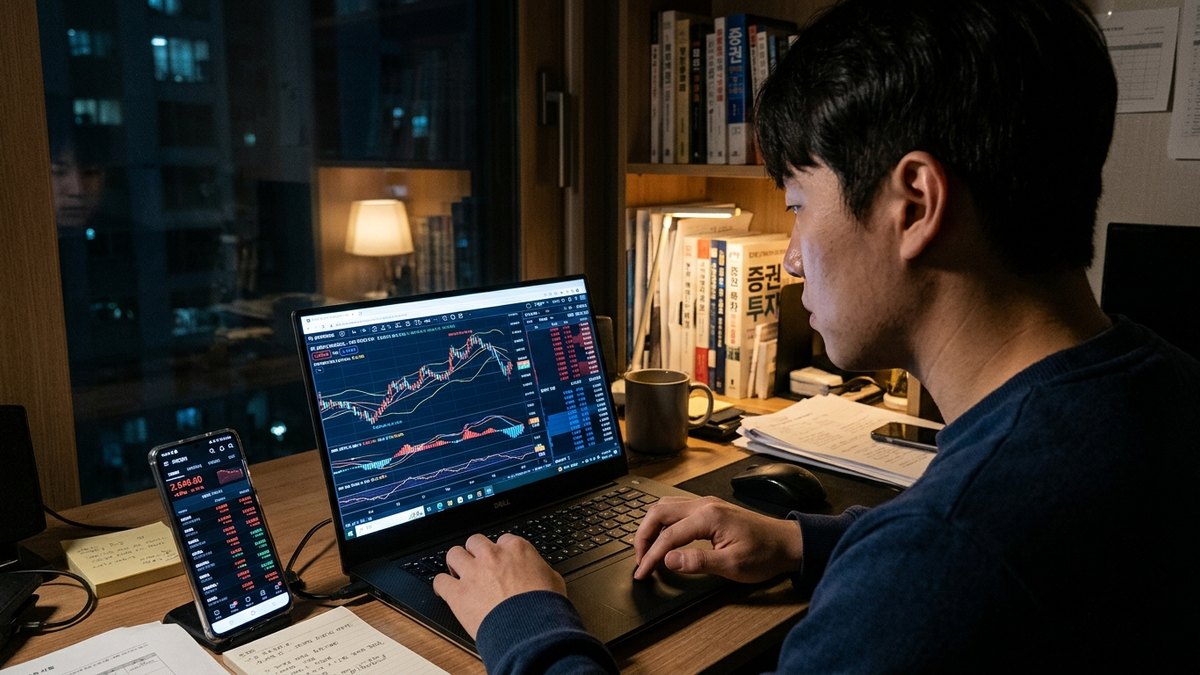
Market data: Korea Exchange regular-session close & Hana Bank USD/KRW reference rate, 2026-11-19 (KST)
The KOSPI stood at 5,061.34 at 14:33 KST on Thursday, down 0.12%, after recovering much of an earlier 2.05% decline. Separately, newly announced Korea-China trade commitments outlined broader access for Korean content producers and travel agencies.
The index opened 0.45% higher at 5,090.04 before falling to 4,963.61, according to KRX figures cited by Financial News. At 14:33, it was 97.73 points above that low, but still 6.10 points below Wednesday’s close.
Because of South Korea’s college entrance exam, the KRX regular stock-market session runs from 10:00 to 16:30 KST on Nov. 19. The index readings are intraday observations, ahead of the delayed close. Exam-day trading schedule.
The reported percentage moves reconcile with the quoted index levels using Wednesday’s 5,067.44 close. This comparison uses KRX levels relayed by Financial News; it checks the arithmetic rather than independently verifying the exchange’s raw feed.
| Observation, Nov. 19 | Reported move | KRX index level cited in the report | Calculated move, five decimal places |
|---|---|---|---|
| Opening | +0.45% | 5,090.04 | +0.44599% |
| Intraday low | -2.05% | 4,963.61 | -2.04896% |
| 14:33 KST | -0.12% | 5,061.34 | -0.12038% |
What does the China agreement cover?
Seoul and Beijing announced the substantial conclusion of services and investment negotiations on Nov. 18. Some technical wording remained to be settled, according to Korea’s trade ministry.
Under the agreement, China committed to most-favoured-nation treatment for Korean films and games, and to nondiscrimination in content reviews. The scope of audiovisual co-production would expand beyond films to dramas, animation, variety programmes and documentaries.
For tourism, the agreement includes a commitment to allow Korean travel agencies established in 23 Chinese regions to arrange outbound trips for residents, including Chinese and foreign nationals.
These are negotiated market-access commitments. The announcement does not establish that individual productions have received approval or that travel agencies can immediately begin the newly covered business. Legal review, formal signing and procedures for entry into force remain ahead, the ministry said.
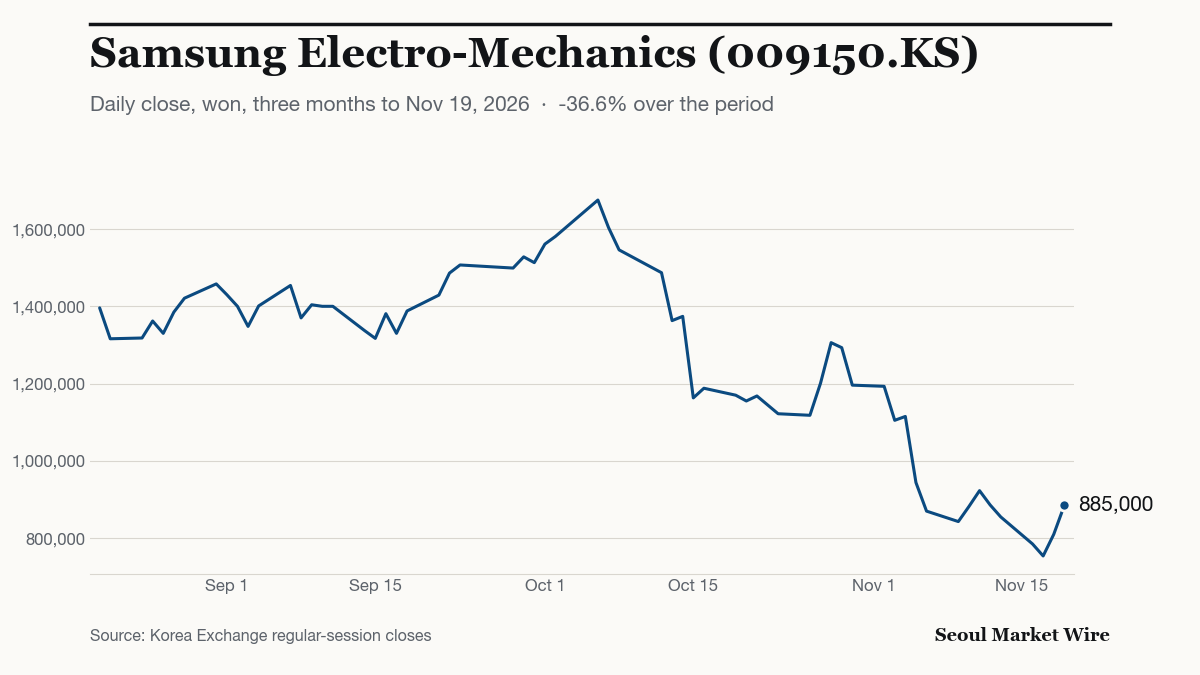
Why can a price target fall while earnings estimates rise?
For Samsung Electro-Mechanics, the distinction was between projected profits and the valuation assigned to them. In its Nov. 19 report, iM Securities lowered its target price to 1.5 million won from 2.1 million won while raising earnings estimates.
The reduction was 28.6%. Citing lower valuation multiples among global peers, the brokerage changed its valuation method from a sum-of-the-parts approach to a price-to-earnings valuation.
It applied a 19-times multiple to estimated 2028 earnings per share. That multiple came from the stock’s 10-year average 12-month forward P/E; the earnings estimate used in the calculation was for 2028. In this report, the lower valuation outweighed the increase in earnings estimates.
Its earnings case rested on package-substrate demand and improved pricing for multilayer ceramic capacitors. The brokerage cited price increases and recently signed long-term supply agreements as support for its earnings forecasts. The projected profit growth remains a forecast.
How does won appreciation affect domestic firms and exporters?
A Bank of Korea study published on Nov. 19 examined how currency appreciation affects households and businesses differently. It analysed economic effects rather than announcing an exchange-rate policy.
For households, the study estimated that a 10% decline in the won-per-dollar exchange rate would reduce the cost of maintaining existing consumption by an average of 165,000 won per household over a year. Food and energy costs were among the channels through which cheaper imports could reach consumers. Yonhap’s account of the report.
For businesses, the BOK estimated that a 10% appreciation would raise operating margins at domestic-oriented firms by 0.5 percentage points more than at exporters in the same industry. That is a relative effect, not an estimate that every domestic firm’s margin would rise by 0.5 points.
The study attributed the difference to lower imported-input costs and stronger domestic demand for domestic-oriented firms, while exporters faced pressure on won-denominated margins.
What to watch next
| KRX ticker or indicator | Key sensitivity | Next catalyst and date |
|---|---|---|
| KOSPI | Whether the intraday recovery holds through the regular session | Nov. 19, 2026, 16:30 KST: scheduled exam-day close |
| Samsung Electro-Mechanics (009150.KS) | Earnings estimates versus the valuation multiple assigned to them | Nov. 19, 2026, 16:30 KST: regular-session close following the target revision; the cited material establishes no next earnings-release date |
| Korea-China services and investment agreement | Legal implementation of negotiated market access | Legal review, signing and entry into force remain pending; the ministry’s Nov. 18 announcement gives no implementation date |
Sources
- Financial News — KOSPI swings around 5,000 in afternoon trade (2026-11-19) n.news.naver.com
- YTN — Exam-day stock-market trading hours (2026-11-19) ytn.co.kr
- Ministry of Trade, Industry and Resources — Korea-China FTA services and investment negotiations (2026-11-18) motir.go.kr
- iM Securities — Samsung Electro-Mechanics: Margin peak is still a long way off (2026-11-19) stock.naver.com
- Bank of Korea — Economic effects of won appreciation, Issue Note 2026-30 (2026-11-19) bok.or.kr