Korean brokerages test memory downside as supply forecasts diverge
Six November reports offer different answers on memory risk: Eugene estimates profits under falling prices, iM models demand lost to policy shocks, and Kiwoom forecasts oversupply in 2027. Hana separates equipment installation from the arrival of additional supply.
Market data: Korea Exchange regular-session close & Hana Bank USD/KRW reference rate, 2026-11-20 (KST)
Korean brokerages disagree on whether memory supply will remain tight through the next investment cycle. Eugene estimates substantial profits even under a price downturn, while iM finds that selected policy shocks would reduce its projected DRAM shortages. Kiwoom forecasts memory oversupply in 2027 and questions the funding available for further AI investment.
Six November reports examined here address pricing, demand, factory capacity and financing. Their conclusions measure different risks: profits can remain high as prices fall, while a smaller physical shortage says little by itself about customers’ ability to pay.
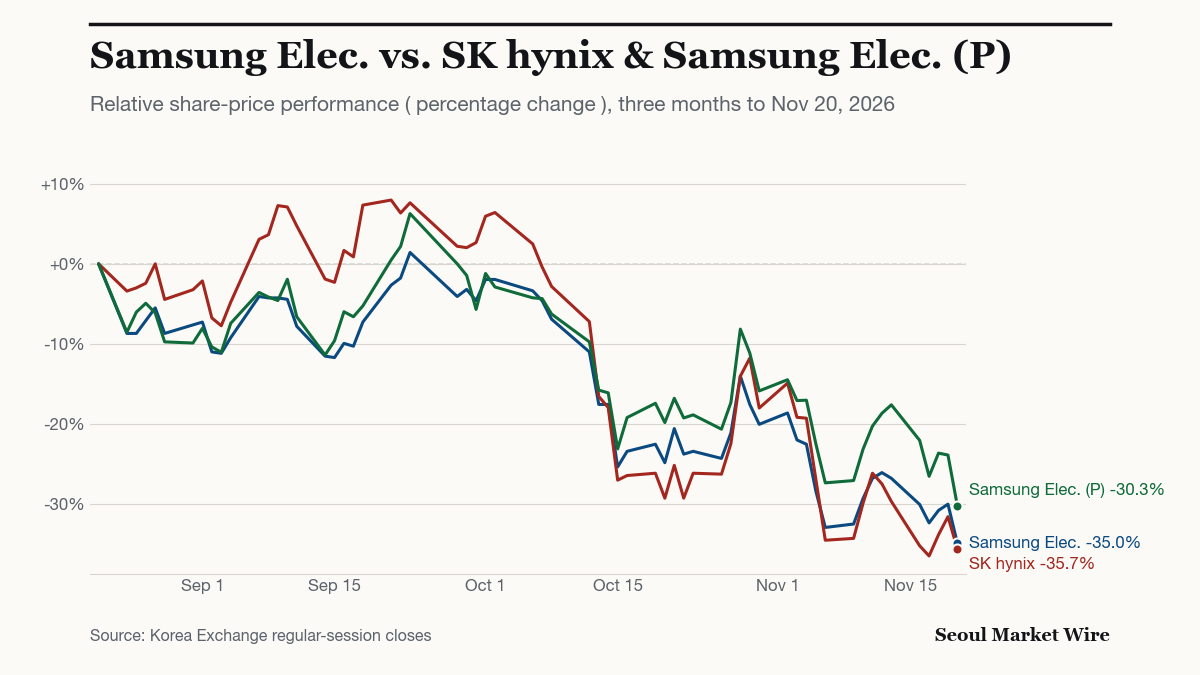
The reports predate the Nov. 20 sell-off. At the Seoul market close that day, Samsung Electronics fell 7.01% to 183,100 won, SK hynix lost 5.92% to 1,113,000 won and the KOSPI dropped 5.21% to 4,869.96. The weekly review covers the week’s trading.
Brokerage scenarios, not company guidance. Eugene’s Nov. 12 and Nov. 19 reports estimate 2028 operating profit in trillion won; iM’s Nov. 16 report measures the 2027 DRAM supply-demand gap as a percentage of projected demand. A negative gap denotes a shortage. The panels show separate calculations.
What would a price downturn do to profits?
The price stress test in Eugene Investment & Securities’ Nov. 12 report applies the 2018 downturn to a future cycle. Its central forecast remains a prolonged memory shortage; the downturn is a low-probability alternative.
In that alternative, NAND prices begin falling in the second quarter of 2027 and DRAM prices in the third. The historical cycle involved cumulative price declines of about 60% before recovery. For high-bandwidth memory, or HBM, the brokerage assumes year-on-year declines in 2028 of about 50% in contract prices and about 40% in blended average selling prices. Those annual HBM assumptions use a different comparison period from the historical cycle’s cumulative decline.
Even under those assumptions, the model puts DRAM operating margins near 70% and NAND margins near 50% in the fourth quarter of 2028. Lower profit-linked bonuses would cushion margins. The analysts also estimate that their assumed prices approach contractual floors, drawing on Micron’s comments about long-term agreements. Contract terms vary by customer. The original price scenarios set out those assumptions.
The Nov. 19 follow-up reiterates the Nov. 12 bear-case estimates for 2028 operating profit: 316.2 trillion won for Samsung and 230.1 trillion won for SK hynix.
With capital-spending assumptions unchanged, capital expenditure would equal 18.0% of Samsung’s sales and 28.7% of SK hynix’s sales in 2028. The analysts interpret those ratios as room to continue investment during a downturn. That conclusion depends on both the earnings model and the spending assumptions. The follow-up report retains the earlier downturn scenario.
How much demand could policy shocks remove?
Two separate calculations in iM Securities’ Nov. 16 report address restrictions on China-bound GPUs and delayed US construction. They test memory quantities rather than company profits.
The first assumes restrictions block 10% of approximately $640 billion in projected Nvidia data-centre revenue for 2027. Converting that revenue into power capacity, processors and memory yields exposure below 2% of projected server memory bits and about 5% of projected HBM bits. The estimated DRAM shortfall narrows from 5.4% to 4.4% of projected demand. This is a hypothetical restriction, not an estimate of enacted sanctions.
In the separate 2028 scenario, half of 25GW in planned US data-centre additions, or 12.5GW, slips into 2029. The modelled DRAM shortfall narrows from 5.1% to 0.6% of projected demand, close to balance.
The delayed capacity represents about 7.1% of projected 2028 server memory bits. The brokerage calls this an upper-bound demand estimate because it applies maximum memory configurations to capacity that would also serve general-purpose servers and storage. The two scenarios concern different years and cannot be added together. iM’s original tables calculate the supply-demand gap as supply divided by demand, minus one.
Where supply forecasts diverge
Factory timing supports the shortage argument. In its Nov. 12 report, Hana Securities expects equipment installation at SK hynix’s Y1 and Micron’s Idaho sites from the first quarter of 2027, followed by Samsung’s P5 in the third quarter. The brokerage expects supply contributions from those additions in 2028 or later. Equipment arrival, factory completion and commercial production are distinct milestones.
Its forecasts put 2027 DRAM capacity growth at 15% and leading-edge foundry capacity growth at 17%. These are brokerage estimates rather than confirmed company schedules. The capacity outlook distinguishes investment timing from additional output.
Against that view, Kiwoom Securities’ November outlook forecasts memory oversupply in 2027. Its concerns extend beyond phones to constraints on AI investment and debt-related credit risks among neocloud providers. Those arguments challenge the assumption that server demand can absorb expanding supply. The original report sets out the oversupply forecast and financing risks.
Physical shortages would not necessarily protect prices either. Eugene’s follow-up argues that customer budgets and resistance to higher prices could force adjustments even before supply catches up. It expects such declines to be gradual and investment to continue. Our pricing analysis examines that distinction.
Can AI customers finance their orders?
Customer prepayments provide one possible source of funding. On Nov. 10, CoreWeave said it expected approximately $9 billion in customer prepayments and deposits over the following three months. Those were anticipated receipts, not cash already secured.
The company also identified financing backed by customer contracts and operating cash flow as funding sources. Its results release describes those expectations.
The announcement concerns expected funding for one operator. The company announcement therefore offers a narrower measure than the industry credit risks raised in the semiconductor outlook.
Where is demand already under pressure?
Smartphones provide a measurable example of resistance to memory prices. Kiwoom reports that average smartphone prices rose 18% year on year in the third quarter of 2026. Memory costs reached 42% of smartphone prices, compared with a 10-year average of 11%.
Memory inventories in smartphone channels stood at 14–18 weeks. The brokerage expects memory content per phone to decline year on year in 2027: DRAM by 2% and NAND by 1%. These figures describe memory per device, not an equivalent decline in total memory demand. The smartphone analysis accompanies its assessment of AI spending and supply.
Trade data show a different kind of weakness. Hana’s Nov. 16 weekly report puts provisional memory exports at a daily average of $1.60 billion for Nov. 1–10, measured per working day. That was up 215% from a year earlier but 7% below October’s average.
DRAM averaged $950 million per working day, up 428% year on year and 6% from October. Daily-average export values for NAND, multi-chip packages and SSDs were respectively 13%, 26% and 52% lower than October’s averages. These are dollar values, not shipment volumes, and they cover part of the month. Hana’s weekly report identifies the figures as provisional.
What do the differences mean for equipment stocks?
Continued investment is central to Eugene’s preference for front-end equipment makers. Over the three months covered by its Nov. 19 report, those stocks returned an average of -30.2%, versus -14.1% for back-end equipment, +5.3% for inspection equipment and -2.6% for test parts.
The brokerage forecasts year-on-year operating profit growth in 2028 of 33% at TES and 57% each at VM and YEST. Those estimates depend on future equipment demand. The equipment analysis links the estimates to continued investment.
For a current earnings comparison, Hana reported that PSK exceeded its quarterly expectations as equipment deliveries to customers proved stronger than anticipated. Its weekly review distinguishes that result from the longer-term forecasts.
| Brokerage | Report date or edition | Key focus |
|---|---|---|
| Eugene Investment & Securities | Nov. 12 | Earnings under a hypothetical 2018-style price downturn |
| Hana Securities | Nov. 12 | Equipment installation timing; 2027 DRAM capacity growth of 15% |
| Hana Securities | Nov. 16 | Provisional export values, NAND uncertainty and equipment earnings |
| iM Securities | Nov. 16 | Separate 2027 export-restriction and 2028 construction-delay scenarios |
| Kiwoom Securities | November outlook | 2027 oversupply, smartphone memory reductions and AI financing constraints |
| Eugene Investment & Securities | Nov. 19 | Pricing pressure, investment capacity and equipment forecasts |
Risks and limits
The comparison covers six reports with different assumptions and measurement periods, rather than a common industry stress test. Their valuation assessments also predate the Nov. 20 decline.
Two additional entries remain in the source index: Hanwha’s Nov. 17 report and SK’s Nov. 12 report. Their original texts could not be independently checked, so their assessments are excluded from this analysis.
What to watch next
| Timing | Event or milestone | Relevant stocks | Status and relevance |
|---|---|---|---|
| Nov. 26, 2026 | Bank of Korea policy-setting meeting | 005930.KS, 005935.KS, 000660.KS | Scheduled on the official calendar; relevant to domestic financing conditions. |
| First quarter of 2027 | Equipment installation at SK hynix’s Y1 site | 000660.KS | Hana’s estimate, not a confirmed production start; installation precedes additional output. |
| Third quarter of 2027 | Equipment installation at Samsung’s P5 site | 005930.KS, 005935.KS | Hana’s estimate; its Nov. 12 report places supply contributions from the new capacity in 2028 or later. |
Sources
- Eugene Investment & Securities — Investment will continue (Nov. 19, 2026) stock.naver.com
- Eugene Investment & Securities — Original report (Nov. 19, 2026) eugenefn.com
- Eugene Investment & Securities — Share prices already reflect a lot (Nov. 12, 2026) stock.naver.com
- Eugene Investment & Securities — Original price scenarios (Nov. 12, 2026) rreport.einfomax.co.kr
- iM Securities — Valuation, and risk versus reward (Nov. 16, 2026) stock.naver.com
11 more sources
- iM Securities — Original scenario analysis and tables (Nov. 16, 2026) imfnsec.tistory.com
- Kiwoom Securities — Semiconductor outlook: When spring comes stock.naver.com
- Kiwoom Securities — Semiconductor outlook: original report bbn.kiwoom.com
- Hanwha Investment & Securities — Nov. 17 report index entry; excluded from the analysis stock.naver.com
- Hana Securities — Supply capacity falls short of AI demand (Nov. 12, 2026) stock.naver.com
- Hana Securities — Original capacity outlook (Nov. 12, 2026) file.hanaw.com
- Hana Securities — Valuations remain undemanding (Nov. 16, 2026) stock.naver.com
- Hana Securities — Semiconductor weekly: original report (Nov. 16, 2026) file.hanaw.com
- SK Securities — Nov. 12 report index entry; excluded from the analysis stock.naver.com
- CoreWeave — Third-quarter 2026 results (Nov. 10, 2026) investors.coreweave.com
- Bank of Korea — Policy-setting meeting dates bok.or.kr