Strong exports may limit won losses as dollar rises, Eugene says
Eugene expects exports to restrain won depreciation despite Fed tightening concerns. Kiwoom identifies oil, higher US yields and safe-haven demand as dollar supports.

Market data: Korea Exchange regular-session close & Hana Bank USD/KRW reference rate, 2026-11-13 (KST)
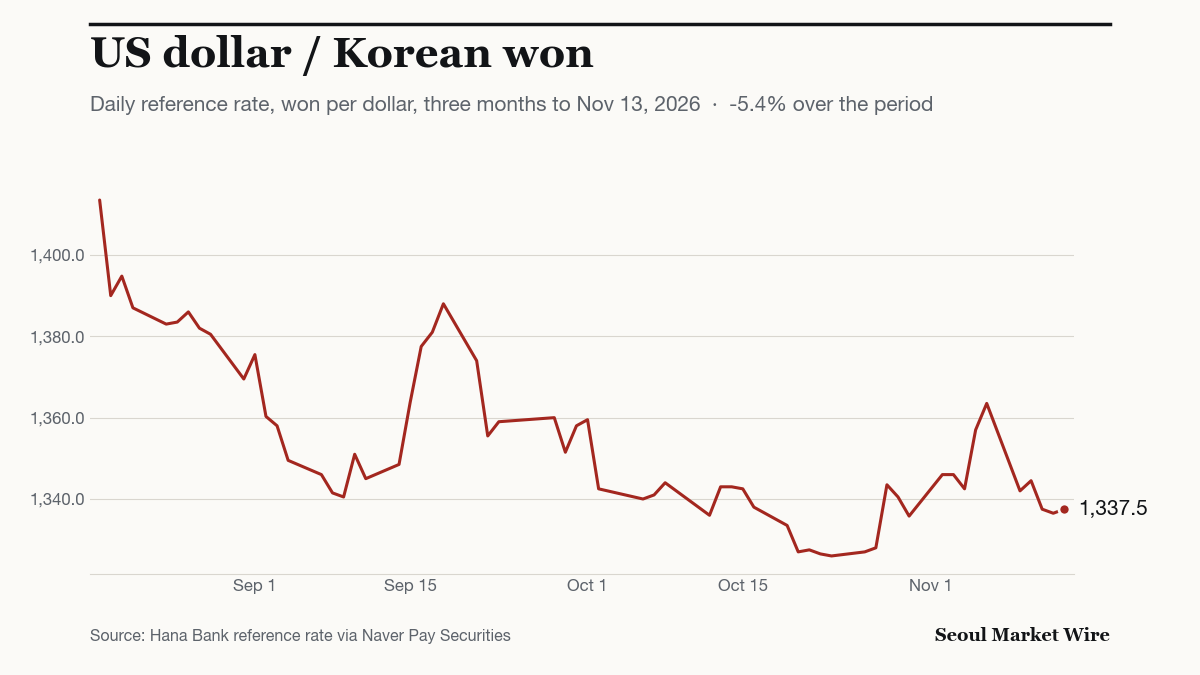
Strong exports could limit won depreciation despite expectations of further Federal Reserve tightening, Eugene Investment & Securities said in its Nov. 12 FICC update. The brokerage expects export strength to restrain a further rise in USD/KRW, even if the dollar strengthens more broadly.
Dollar strength has three drivers in Kiwoom Securities’ Nov. 13 FX daily: higher oil prices, the US 10-year Treasury yield above 5% and safe-haven demand during a sell-off in US technology shares. These pressures can coexist with export support for the won.
What supports the won?
Exporter dollar sales helped the won withstand US inflation concerns in the session covered by Eugene’s update. The brokerage also identified foreign buying of Korean equities as a source of support for the currency.
The export figures show why the brokerage sees a buffer. In a Nov. 12 economy brief, iM Securities reported that Korea’s semiconductor exports rose 331.2% from a year earlier during Nov. 1–10, while computer peripheral exports increased 237.7%. Korea’s total exports to China and the United States rose 148% and 163%, respectively, over the same period, according to the report.
For its analysts, that performance argues against declaring that the chip cycle has peaked. They also viewed CoreWeave’s better-than-expected third-quarter results and investor demand for Anthropic’s planned IPO as signs that concerns about AI investment and credit were easing. The analysts cautioned that the final IPO outcome and post-listing share performance were still uncertain.
Why is the dollar strengthening?
US headline consumer prices rose 0.4% month on month in October on a seasonally adjusted basis, according to the Bureau of Labor Statistics. Core prices, excluding food and energy, increased 0.3%, matching the gains in August and September.
In its separate Nov. 11 inflation analysis, Eugene’s base case was a 25-basis-point December rate increase to 4.00–4.25%. That was a brokerage forecast; the Fed’s Oct. 28 decision left the target range at 3.75–4.00%.
Oil adds another source of inflation concern. Kiwoom attributed the dollar’s rise to Middle East military tension and fears of supply disruption, which it linked to higher oil prices and Treasury yields. Its analysts also identified risk aversion during the technology-share decline as a source of demand for the dollar.
Could weaker consumption limit US yields?
In its outlook for Nov. 16–20, Kiwoom’s weekly macro report anticipates slower growth in October US retail sales. It argues that weaker consumption could limit further rises in Treasury yields and reduce expectations of additional tightening. Conversely, a hawkish tone in the October FOMC minutes or Fed officials’ comments could restrict any decline in yields. Kiwoom expects dollar volatility to increase as markets weigh weaker consumption against the risk of further Fed tightening.
What could weaken export support?
Delays in data-centre construction could materially hurt Korea’s chip exports in 2027, according to iM. Its report treats those delays as a risk whose impact had yet to materialise in the export figures.
Sources
- Eugene Investment & Securities — Eugene's FICC Update (Nov. 12, 2026), page 2 stock.pstatic.net
- iM Securities — AI investment cycle fears versus reality: Korea's chip export surge (Nov. 12, 2026) stock.naver.com
- iM Securities — Official publication of the AI investment and chip export report (Nov. 12, 2026) imfnsec.tistory.com
- Kiwoom Securities — Dollar rises on tightening caution (Nov. 13, 2026) stock.naver.com
- Kiwoom Securities — Weekly Macro: Slowing consumption meets Fed tightening caution (Nov. 13, 2026) stock.naver.com