Kiwoom favours 25bp Fed hike as financial-conditions growth boost fades
Kiwoom expects a quarter-point December increase as financial conditions provide less support to growth. FCI-G does not show how much additional tightening the economy can absorb.
Market data: Korea Exchange regular-session close & Hana Bank USD/KRW reference rate, 2026-11-13 (KST)
Kiwoom Securities expects the Federal Reserve to raise rates by 25 basis points at its Dec. 8–9 meeting, arguing that fading support for growth from financial conditions favours gradual tightening.
But the Fed’s growth-impact gauge measures the effects of past financial changes. It does not show how much additional tightening the economy can absorb.
What does FCI-G measure?
The Fed publishes two versions of its Financial Conditions Impulse on Growth index: a baseline incorporating changes over the preceding three years and a one-year-lookback series. Those windows describe past changes, not the forecast horizon.
Both combine seven variables: the federal funds rate, the 10-year Treasury yield, the 30-year fixed mortgage rate, BBB corporate bond yields, equity prices, house prices and the dollar. They estimate the effect on real GDP growth over the following year, accounting for lags. Negative readings indicate a growth boost; positive readings indicate a drag.
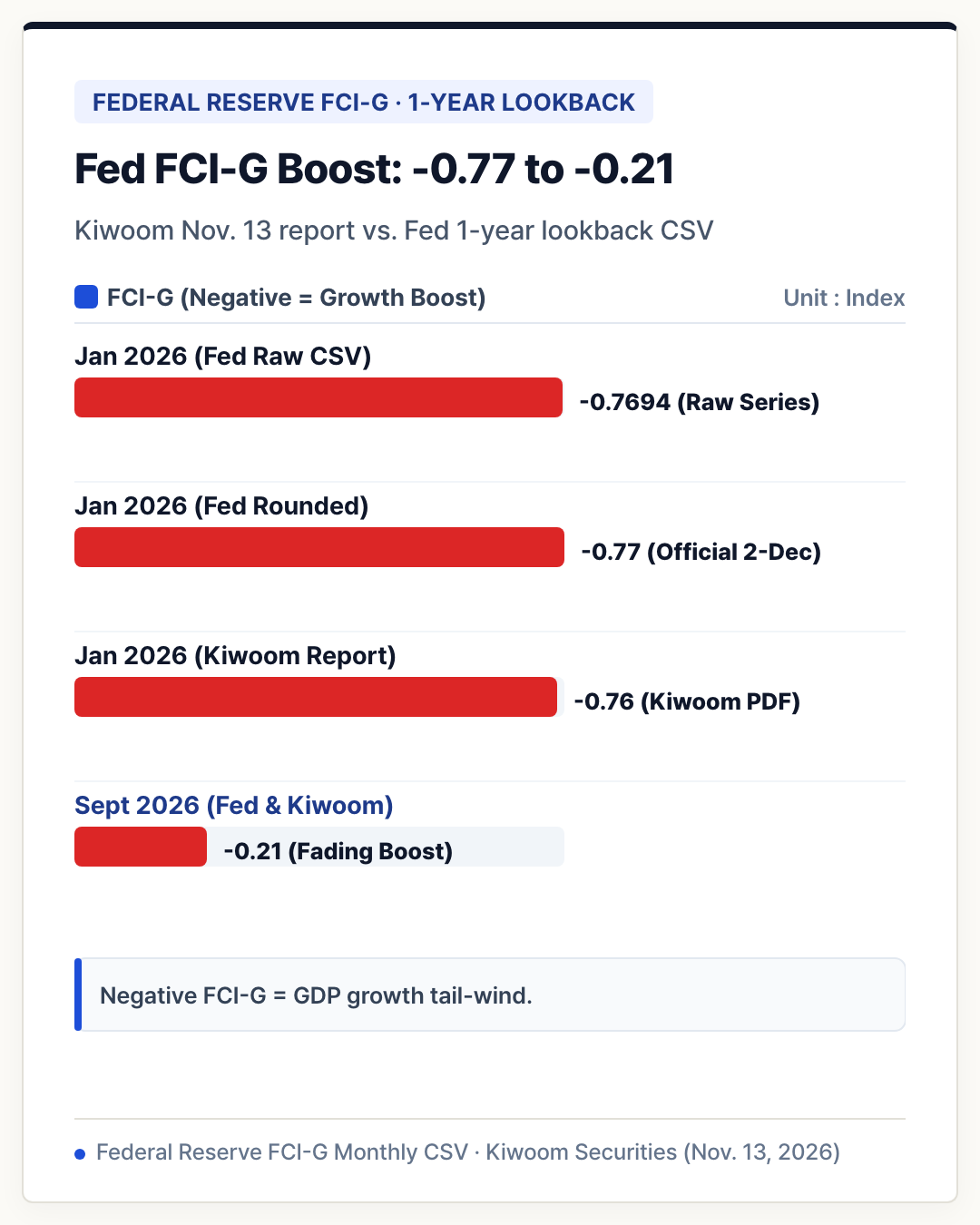
In its Nov. 13 report, the brokerage put FCI-G at -0.21 in September 2026, up from -0.76 at the start of the year. The September figure corresponds to the Fed’s one-year-lookback version, although Kiwoom did not specify a lookback window.
The Fed’s currently available one-year-lookback series rounds to -0.77 for January and -0.21 for September. Kiwoom described its comparison as showing a smaller estimated boost to growth; its -0.76 starting figure should not be read as the current official January value.
| Metric / Series | Jan. 2026 Reading | Sept. 2026 Reading | Implied Shift (pp) | Notes & Source |
|---|---|---|---|---|
| Kiwoom Nov. 13 Report | -0.76 |
-0.21 |
+0.55 pp |
Lookback window not specified in report text |
| Fed FCI-G (1Y Lookback Raw CSV) | -0.7694 |
-0.2108 |
+0.5586 pp |
Official Federal Reserve monthly public CSV |
| Fed FCI-G (Rounded 2-Dec) | -0.77 |
-0.21 |
+0.56 pp |
Standard two-decimal rounding of official series |
A separate part of the brokerage’s case concerns employment. Kiwoom cited a smaller labour-market imbalance than in 2022 and slower wage growth as reasons to favour smaller increases.
The Fed calls FCI-G an approximation. It omits influences such as changes in lending standards and loan terms, so a negative reading cannot establish that financial conditions as a whole are loose.
What do the inflation data show?
US consumer prices rose a seasonally adjusted 0.4% in October from September, while prices excluding food and energy increased 0.3%, according to the Bureau of Labor Statistics’ Nov. 10 release.
Year-on-year headline and core CPI rates were unavailable because the BLS did not collect October 2025 survey data during a lapse in government funding. Those missing comparisons are separate from the published monthly increases.
The monthly detail was mixed. Used-car and truck prices fell 1.2%, while shelter costs rose 0.3% and transportation services increased 0.8%.
Persistent core inflation complicates the case for smaller increases. In its Nov. 13 weekly report, Daol Investment & Securities warned that core inflation could remain elevated for some time, leaving scope for wider interest-rate swings.
The Census Bureau is scheduled to publish its October advance retail-sales report at 22:30 KST on Nov. 17.
How does this reach Korean equities?
The US-Korea interest-rate gap could limit sustained foreign buying of Korean equities, according to Yuanta Securities Korea’s Nov. 13 strategy report. That is the brokerage’s assessment of a potential constraint on flows, rather than an explanation of a particular day’s trading.
Separately, foreign investors were net sellers of KOSPI shares on Nov. 13, when the index closed down 0.98% at 5,290.53.
What to Watch Next (KRX Tickers & Catalyst Dates)
| Ticker / Indicator | Name / Benchmark | Key Sensitivity | Next Catalyst & Date |
|---|---|---|---|
| USD/KRW | Won-Dollar Spot Rate | US-Korea policy rate differential & foreign equity flows | US Oct. Advance Retail Sales (Nov. 17, 22:30 KST) |
| 005930.KS / 000660.KS | Samsung Electronics / SK hynix | Foreign institutional net buying & US Treasury yield swings | FOMC Policy Decision (Dec. 8–9, 2026) |
| 105560.KS / 055550.KS | KB Financial / Shinhan Financial | Domestic NIM, household lending spreads & BOK rate path | Bank of Korea Monetary Policy Board (Nov. 2026) |
Sources
- Kiwoom Securities — Macro catch-up: Changes in financial conditions set the pace of Fed tightening (Nov. 13) stock.naver.com
- Daol Investment & Securities — Market Weekly: Check ME up! (Nov. 13) stock.naver.com
- Yuanta Securities Korea — QWER, November week 2: Screening strategy for the third-quarter earnings season (Nov. 13) stock.naver.com
- Federal Reserve — A New Index to Measure U.S. Financial Conditions federalreserve.gov
- Federal Reserve — FCI-G monthly data, one-year lookback federalreserve.gov
5 more sources
- Federal Reserve — FOMC meeting calendars federalreserve.gov
- Bureau of Labor Statistics — October 2026 Consumer Price Index bls.gov
- US Census Bureau — Monthly Retail Trade release schedule census.gov
- Yonhap News Agency — KOSPI closes down 0.98% (Nov. 13) yna.co.kr
- Aju Press — KOSPI falls 0.98% amid foreign selling (Nov. 13) ajupress.com