How to read Korean retail investors' U.S. stock flows
Direct overseas share purchases and Korea-listed foreign-equity ETFs are separate channels. Holdings dates, product structure and currency funding matter when interpreting the flows.

Market data: Korea Exchange regular-session close & Hana Bank USD/KRW reference rate, 2026-11-13 (KST)
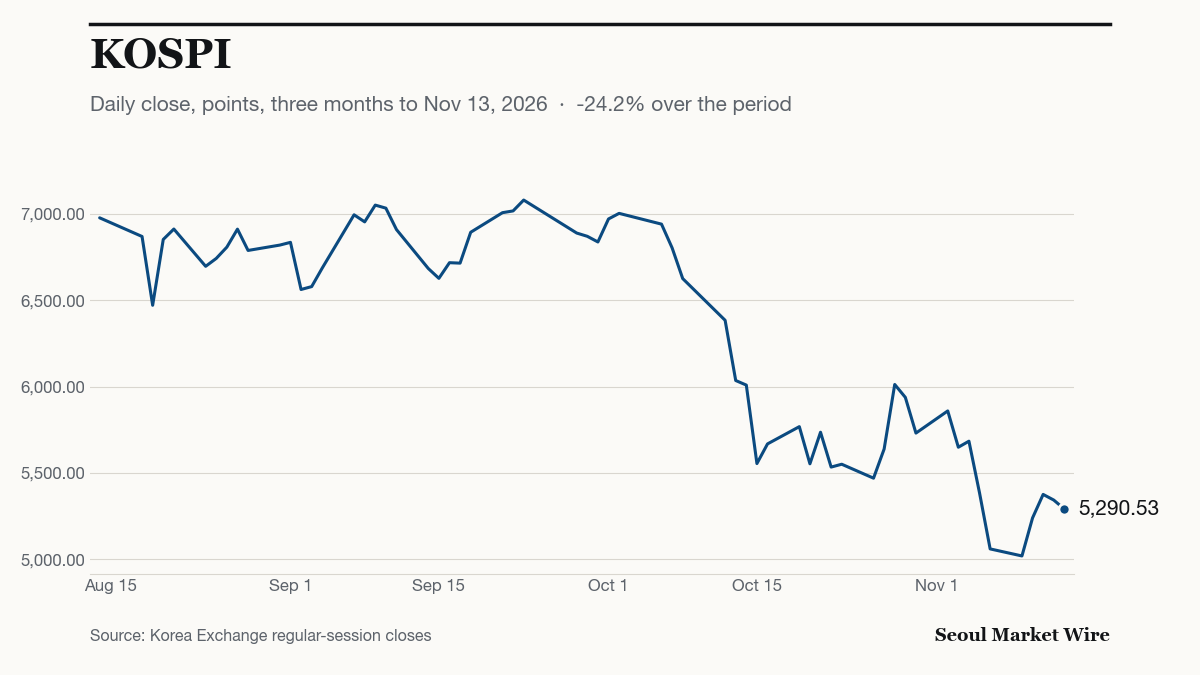
How should readers interpret Korean retail investors’ U.S. stock flows? Start by separating purchases over a period from holdings on a particular date, then distinguish direct overseas investment from Korea-listed foreign-equity ETFs.
Korea’s “seohak ants” are individual investors who buy shares abroad, mainly in the United States, according to the Bank of Korea’s glossary.
What they buy abroad
The BOK’s December 2025 Financial Stability Report, using holdings data as of end-October 2025, highlighted concentration in a small group of U.S. stocks and exposure to leveraged and inverse ETFs. Its discussion included Apple, Microsoft, NVIDIA, Amazon, Alphabet (Google’s parent), Tesla and Meta, known as the “Magnificent Seven.”
The report linked concentration and exposure to these products to vulnerability to market shocks. That describes portfolio exposure at the stated date; it does not establish which security leads new purchases in any particular period.
An ETF also needs to be identified by its objective. For example, Direxion’s SOXL seeks three times the daily performance of the NYSE Semiconductor Index before fees and expenses. Its SOXS counterpart seeks three times the inverse daily performance. The issuer’s product documentation says neither should be expected to deliver that multiple of the index’s cumulative return over periods longer than one day.
How to read the flows
A net-purchase ranking orders securities by purchases minus sales over a stated period. A holdings ranking orders positions by their value on a stated date.
Direct overseas share purchases and Korea-listed foreign-equity ETFs are separate channels. Box 7 of the BOK report excludes the latter from its measures of domestic and overseas equity net investment.
That analysis describes periods of net buying in both markets, followed by a stronger substitution pattern in September–October 2025. Overseas net purchases alone do not identify where the money came from.
Why the won connection matters
Overseas investment can increase demand for foreign currency when investors convert won to fund purchases. In its research on overseas investment and investment income, the BOK finds that expanding overseas investment puts upward pressure on the won-per-dollar exchange rate, while income from external assets can partly offset that pressure through foreign-currency supply.
Those are different transactions. Money committed abroad creates investment exposure; interest and dividends generate income. Income earned overseas does not necessarily return to Korea’s foreign-exchange market. Earnings retained or reinvested abroad can limit the supply of foreign currency reaching that market.
The research examines overseas investment and income across the economy, including corporate earnings retained abroad. Its conclusions do not quantify the exchange-rate effect of Korean retail purchases of an individual stock.
Which product rules apply
Korean safeguards cover domestically and overseas-listed single-stock leveraged products, including inverse products. SOXL and SOXS track a semiconductor index, so they are not examples of single-stock products. These safeguards are separate from the rules for buying ordinary U.S. shares.
Since July 31, 2026, the KRW30 million minimum cash-deposit requirement has applied to both initial and additional purchases of these products by individual retail investors. Existing investors must also meet it when buying more; selling is permitted regardless of that deposit requirement.
The prior-learning requirement totals three hours: a one-hour basic course and a two-hour in-depth course. It is distinct from the cash-deposit and mock-trading requirements. Our guide to single-stock leveraged products explains the Korean framework.
The mock-trading requirement took effect on August 19, 2026, for both domestically and overseas-listed single-stock leveraged products. Investors with qualifying trading experience in those products before that date are exempt from mock trading; this exemption does not remove the cash-deposit requirement for additional purchases.
The KRX mock-trading service is free and accessible through its website. Required participation is at least one hour on each of a minimum of five trading days. Those days do not have to be consecutive.
Sources
- Bank of Korea — 800 Economic and Financial Terms: Seohak ants, page 168 bok.or.kr
- Bank of Korea — Financial Stability Report, December 2025: retail overseas investment bok.or.kr
- Bank of Korea — The Effects of Overseas Investment and Investment Income on the Exchange Rate bok.or.kr
- Direxion — Daily Semiconductor Bull and Bear 3X ETFs direxion.com
- Financial Services Commission — Strengthened Investor Protection Measures for Single-Stock Leveraged Products fsc.go.kr