Slower US retail sales growth may curb yield gains, but Fed hike risk remains
Kiwoom expects slower retail sales growth to limit further Treasury yield increases, but its December forecast still calls for a quarter-point Fed rate rise.

Market data: Korea Exchange regular-session close & Hana Bank USD/KRW reference rate, 2026-11-13 (KST)
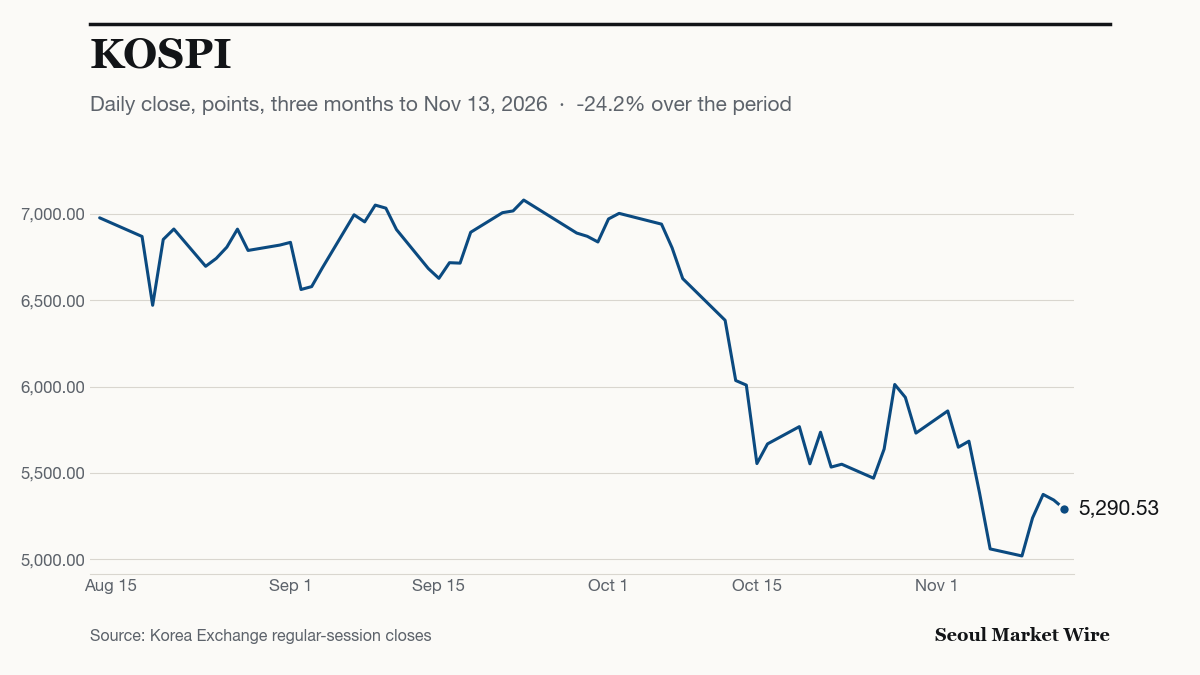
Slower U.S. retail sales growth could restrain further increases in Treasury yields, according to Kiwoom Securities’ Nov. 13 weekly outlook. But the brokerage expects inflation concerns to limit any decline, and its separate analysis still forecasts a Federal Reserve rate increase in December.
The distinction is between a slower rise in market yields and a reversal in monetary policy. The brokerage’s softer-consumption case allows for some easing in expectations of further tightening without assuming that the Fed has finished raising rates.
What would slower sales growth mean?
October’s advance retail sales report is due at 8:30 a.m. EST, or 22:30 KST, on Nov. 17. September retail and food services sales rose 0.8% from the previous month. The figures are adjusted for seasonal, holiday and trading-day effects, but not for inflation. Census release schedule, retail sales data.
A smaller positive monthly reading would therefore mean slower growth in nominal sales, rather than a decline in their level. It would not, by itself, establish a fall in inflation-adjusted consumption.
For Kiwoom’s argument to hold, the release would need to show consumption losing momentum. Its analysts expect such evidence to restrain further yield increases, while continued concern about inflation could keep yields elevated.
Could the Fed minutes offset that restraint?
The brokerage warns that the forthcoming October FOMC minutes could strike a hawkish tone on inflation, limiting any decline in Treasury yields. That is a forecast about an unpublished document.
Minutes of the Oct. 27–28 meeting are scheduled for release at 2 p.m. EST on Nov. 18, or 04:00 KST on Nov. 19. Federal Reserve November calendar.
In its separate Nov. 13 report on financial conditions, Kiwoom expects a 25-basis-point Fed rate increase in December, while acknowledging the possibility of a 50-basis-point move. Its analysts argue that reduced labour-market imbalances and slower wage growth than in 2022 lessen the need for aggressive tightening.
Their assessment has two parts: financial conditions still support growth, leaving room for further tightening, but that support is diminishing. The December FOMC meeting is scheduled for Dec. 8–9, U.S. time. Kiwoom analysis, Fed meeting calendar.
What was the market and data backdrop?
In Seoul, the KOSPI closed down 0.98% at 5,290.53 on Nov. 13. That close preceded the October U.S. retail sales release.
The October employment report, released on Nov. 6, showed payroll growth of 165,000, compared with a revised 60,000 in September. Average hourly earnings for all employees on private nonfarm payrolls rose 0.4% from the previous month. Bureau of Labor Statistics employment report.
The University of Michigan’s preliminary November survey put year-ahead inflation expectations at 4.3% and long-run expectations at 3.4%, down from 4.7% and 3.5% in October. Its final November survey is due at 10 a.m. EST on Nov. 20, or midnight KST on Nov. 21. University of Michigan Surveys of Consumers.
Sources
- Kiwoom Securities — Weekly Macro: Slowing consumption and caution over Fed tightening (Nov. 13, 2026) stock.naver.com
- Kiwoom Securities — Changes in financial conditions set the pace of Fed tightening (Nov. 13, 2026) stock.naver.com
- Naver Pay Securities — KOSPI historical daily data finance.naver.com
- U.S. Census Bureau — Retail trade release schedule census.gov
- U.S. Census Bureau — Monthly retail and food services sales census.gov
4 more sources
- Bureau of Labor Statistics — Employment Situation bls.gov
- Federal Reserve — November 2026 calendar federalreserve.gov
- Federal Reserve — FOMC meeting calendar federalreserve.gov
- University of Michigan — Surveys of Consumers sca.isr.umich.edu